Strategic Deployment and Technical Superiority: HICLOVER Waste Incinerators in Advanced Industrial and Crisis Zone Applications
Engineering Reliability and Global Compliance: The Technical Foundation of HICLOVER Waste Incinerators
The evolution of waste incinerators has become a cornerstone in addressing the growing complexity of hazardous waste management, especially under global pressures for higher environmental standards and operational resilience. Within the first 150 words, it is imperative to acknowledge that an effective waste incineration system is defined by its incinerator residency time, adherence to medical incinerator operating temperature standards, and robust engineering reliability. HICLOVER waste incinerators consistently achieve primary chamber temperatures of 850–1100°C with secondary chambers maintaining at least 1100°C, ensuring full pathogen destruction and compliance with WHO, EU, and national regulatory frameworks. These thresholds are not only benchmarks for safety but also serve as requirements in the context of global infectious disease preparedness and the rapid escalation of COVID-19 waste generation. For engineers evaluating HICLOVER incinerator for COVID-19 waste, understanding technical parameters such as retention time, combustion air control, and dual chamber configuration is critical in meeting both current and emergent waste disposal challenges.
Informational Layer: Technical Specification, Combustion Principles, and Regulatory Frameworks
Incinerator Residency Time and Chamber Technology
At the core of any compliant thermal destruction system lies the principle of sufficient incinerator residency time—the duration combustion gases remain within the high-temperature secondary chamber. HICLOVER’s dual-chamber architecture, featuring residence times of over two seconds at 1100°C, guarantees the complete oxidation of hazardous organics and viral agents. This engineered solution satisfies both EU Directive 2000/76/EC and WHO guidelines for hazardous and infectious medical waste, ensuring that dioxins and furans are minimized to levels below international emission thresholds.
The design also integrates refractory linings capable of withstanding repeated thermal shocks, while maintaining temperature uniformity critical for reliable destruction efficiency. Primary chambers handle the initial volatile release and combustion, with secondary chambers tasked with final gas-phase oxidation, directly supporting both safety objectives and regulatory mandates.
Combustion Principles and Air Control
Optimal combustion is achieved through precise stoichiometric air distribution, variable-speed blowers, and PLC-monitored fuel injection. HICLOVER waste incinerators utilize a combination of primary, secondary, and tertiary air injection, all continuously monitored to maintain oxygen excess in the 6–8% range during active burn cycles. This advanced control not only increases burnout efficiency, but also mitigates carbon monoxide spikes and reduces particulate emissions, aligning with increasingly strict ESG compliance requirements in industrial and healthcare sectors.
For a deeper technical examination, refer to [https://www.google.com/search?q=medical+incinerator+secondary+chamber+temperature+standard](www.google.com/search?q=medical+incinerator+secondary+chamber+temperature+standard), where foundational details regarding secondary chamber temperature protocols and international compliance standards are available for further investigation.
Emission Abatement: Wet and Dry Scrubber Integration
Meeting the demands for low environmental impact, HICLOVER offers both wet and dry scrubbing systems as modular add-ons. Dry scrubbers use alkaline reagents for acid gas capture, while wet scrubbers employ water-based absorption and particulate removal. The choice between these is often dictated by local emission standards, water availability, and ease of maintenance—key factors engineers must balance against project constraints in decentralized waste management scenarios and humanitarian deployments.
To further enhance operational safety, systems are equipped with automatic temperature logging, remote telemetry, and safety interlocks—features that support regulatory documentation and real-time audits during crisis events or remote site operation.
Commercial Investigation Layer: Modular Choices, Automation, and Field Application
Fixed vs. Containerized Incinerators: Engineering for Environment and Mobility
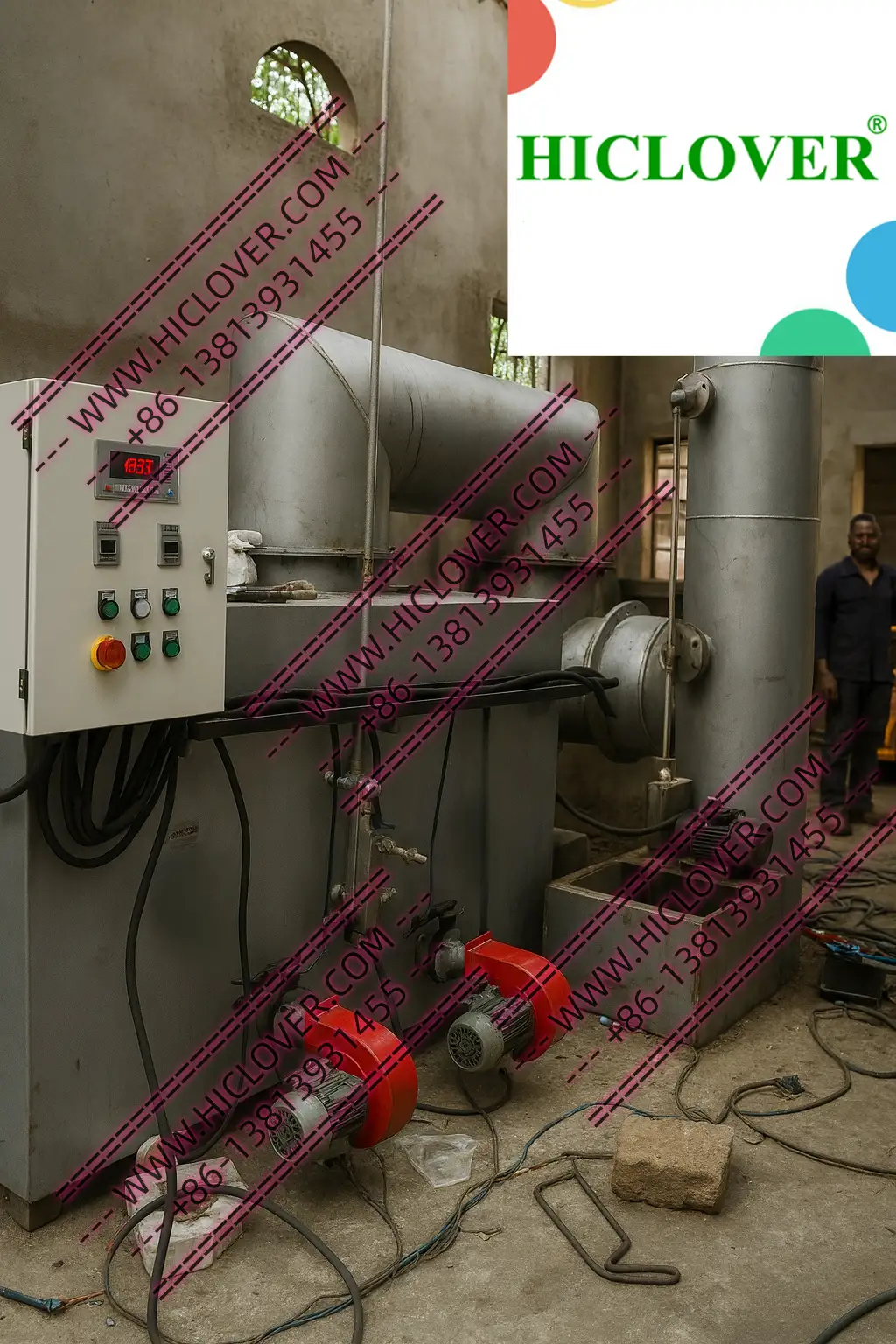
Selecting between fixed-installation and containerized HICLOVER incinerators is a matter of operational context. Fixed systems, often specified for urban hospitals and large industrial facilities, offer expanded throughput and integrated flue gas treatment infrastructure. In contrast, HICLOVER’s containerized modular incinerators are engineered for rapid deployment in remote mining or oil camps, border quarantine stations, and field hospitals where infrastructure is limited, and mobility is paramount.
Containerized modules are shipped as turnkey units—factory-assembled, tested, and validated prior to dispatch. This manufacturing model guarantees supply chain resilience, consistent quality, and reduces on-site commissioning time to a matter of days. Plug-and-play electrical and fuel connections enable quick operation, a decisive advantage for crisis zones and humanitarian camps facing unpredictable waste loads and logistical constraints.
For additional technical details on product configurations and real-world deployments, visit the HICLOVER technical resource center at https://www.hiclover.com/.
PLC Automation vs. Manual Operation: Precision and Data Integration
Digital automation has emerged as an indispensable trend in industrial waste management. HICLOVER waste incinerators leverage PLC control systems to orchestrate temperature modulation, air-to-fuel ratio management, and emission abatement processes—all with operator-friendly HMIs and secure data logging. This not only improves combustion consistency and safety but provides digital traceability for regulatory and ESG reporting.
Manual systems, while lower in initial cost, are increasingly reserved for small-scale or non-critical applications due to operational variability and the lack of integrated safety redundancies. For organizations prioritizing compliance, energy efficiency, and digital oversight, automated HICLOVER models are the preferred standard.
Scrubber Selection: Dry vs. Wet in Variable Operating Environments
When evaluating emission control, the choice between wet and dry scrubber modules depends on both environmental context and lifecycle cost. Dry scrubbing units deliver simplicity and lower water demand, reducing maintenance in arid or remote deployments. Wet scrubbers, offering superior acid gas absorption and fine particulate capture, are often mandated in urban or coastal environments where stricter emission permits prevail.
HICLOVER’s modular approach provides engineers with the ability to select, retrofit, or upgrade emission abatement systems based on evolving site requirements and policy changes—an essential consideration in future-proofing investments against shifting regulatory landscapes and heightened carbon emission reduction pressures.
Transactional Layer: Direct Manufacturing, Customization, and Global Support
Factory Direct Supply and Stable Global Logistics
Unlike intermediaries or trading companies, HICLOVER is an established manufacturer with over 16 years of engineering experience in thermal waste destruction systems. Direct factory supply ensures traceable material sourcing, continuous production oversight, and price transparency—critical factors for procurement teams under scrutiny for ESG compliance and supply chain resilience.
HICLOVER’s production facilities are configured for parallel manufacturing of both standard and custom chamber volumes, with rigorous QA protocols and batch testing. This vertical integration minimizes lead times and mitigates risks of supply disruption, a frequent concern in decentralized or crisis-prone markets.
Customizable Volume and Fuel Flexibility
The variability of waste streams—from high-volume municipal loads to specialized animal incinerator applications—demands flexibility in both chamber sizing and fuel compatibility. HICLOVER offers units ranging from compact mobile models (50–150 kg/h) to large continuous-feed systems exceeding 1000 kg/h. Multi-fuel capability (diesel, LPG, natural gas) is standard, enabling operation in regions with inconsistent energy infrastructure.
Chamber customization further extends to refractory thickness, burn cycle programming, and optional energy recovery integration, allowing clients to tailor systems for both routine and surge scenarios, including pandemic-driven waste surges.
Global Export, Commissioning, and Remote Support
HICLOVER’s export logistics are engineered for global reach, with CE certification, multilingual documentation, and region-specific compliance kits. Factory engineers provide remote commissioning and training, supported by digital diagnostics and live technical support—an operational necessity for installations in geographies with limited local expertise.
This hands-on approach is further strengthened by robust aftersales parts supply, operator training modules, and performance monitoring services, ensuring long-term operational reliability regardless of deployment context.
Animal Incinerator Price and Market Positioning
Price transparency in the animal incinerator price segment is driven by both technical specification and aftersales value. HICLOVER’s direct manufacturing model eliminates intermediary markups, while its modular design philosophy allows for cost-effective scaling and adaptation to veterinary, agricultural, or municipal animal waste disposal requirements. These attributes position HICLOVER at the intersection of cost efficiency, engineering reliability, and rapid deployment capacity.
Brand Value, Market Positioning, and Customer Benefits
HICLOVER’s reputation is founded on engineering precision, application agility, and global compliance. The brand’s market positioning reflects a commitment to advanced, automated waste management solutions that directly support decentralized waste treatment, infectious disease response, and ESG-driven procurement strategies. The integration of containerized modular systems, PLC automation, and dual combustion chambers has enabled rapid rollout in crisis zones and emerging markets where both speed and compliance are paramount.
Customers benefit from factory-direct customization, fast-track deployment, and an engineering team with deep sector expertise—attributes that are especially valuable where waste streams fluctuate rapidly, or where regulatory standards require continuous data-driven documentation. HICLOVER’s supply chain resilience, digital automation, and flexible emission control options further ensure that investments remain future-proof against an evolving global landscape marked by pandemic threats, carbon reduction mandates, and increasing scrutiny on operational traceability.
For technical documentation, customization consultations, or to request a quotation for HICLOVER incinerator for COVID-19 waste or animal waste disposal, technical professionals are invited to engage directly with the manufacturer via the established contact channels at https://hiclover.com/contact/.